Participatory Culture is something which has been widely and
exceedingly prevalent in the last few years. As Jenkins
et al. states, it is a culture “which members believe their contributions
matter, and feel some degree of social connection with one another – at the
heart of the movement.” Jenkins then goes on to showcase how participatory
culture encompasses 4 main features.
Affiliations – Memberships whereby online communities can communicate
Expressions – The production of content
Collaborative Problem-Solving – Collaboration in teams
Circulations – Shaping that of media
Ellcessorbuilds on Jenkin’s theory, applying it to social movements. She argues that
that to solve the world’s biggest issues, one must utilise the web and its
technologies of communication, transparency and collective intelligence.
These theories are showcased through multiple online
communities including that of the social community Black Lives Matter. In fact
their very website reads:
This one sentence happens to exemplify Jenkin’s four
features and Elcessor’s argument and thus participatory culture as a whole.
Examples of BLM collaboration include the following artworks:
As Dianiwrites, contemporary social movements and their success are due to the culture,
technologies, infrastructure and national boundaries of their era. BLM current
era involves such technologies as search engines like YouTube and Google.
YouTube as an online media vehicle is very powerful. It is
the second largest search engine, the third largest social media network and it
facilitates amateur work, educational videos, entertainment and more (Mushroom
Networks). As a result, BLM allows for those involved in the movement to
create their own videos and upload them to YouTube to share their message and
bring about activism. The theory of moral panic is at play here as BLM attempts
to spread the apparent issue which they are hoping to remove. As Burgess and Green
state, “moral panics are further amplified by the utopian hyperbole about ‘Web
2.0’ and the democratization of cultural production.” YouTube revolves around
Web 2.0 and so provides a network whereby BLM can amplify their message.
The following is a YouTube video created by multiple BLM
members for the sole purpose of spreading their message and bringing about change.
Yet this works 2 ways. Though videos are uploaded for BLM,
many are uploaded to argue against and convey the other side of the movement.
Thus YouTube is rather democratic as it portrays all sides
including BLM, the social groups targeted by BLM and those against it.
Google, the largest search engine, is argued by Carrto be making its users more stupid and argued by Turkleto be making its users less communicative. Yet, in terms of the BLM movement,
it is doing the exact opposite. It allows for great communication of its
members as users can locate the social networks of BLM through Google. Users
can also discover forums and information related to the group through the
search engine and so it widely benefits BLM.
Google and YouTube facilitate the participatory culture
which has been so necessary to BLM in gaining a voice and subsequently support.
The
Black Lives Matter movement has brought about a lot of support from many
different areas across the world. What the movement embodies and encompasses is
in all honestly for the best. The Black population wants fairness and equality
in their lives and the movement seems to have the view that the police force
targets their people specifically over other races. Is
this true? Are Police racist? Do they have an agenda against the Black
population? It
is truly a grey matter. There is no doubt that racism exists and you would be
pretty hard pressed to find a police force where everyone deems all races
equally. Yet to say that all Police are racist and unfair is a huge exaggeration
and overstatement. The
Police are no doubt perfect yet they are a force for goodness in the world and
so need to represent such goodness in all their employees. Thus when one lone
policeman shoots a Black person in arguably a wrong scenario, the news is
spread rapidly and the supposed ‘goodness’ of the police force is heavily
argued about. When such a scenario happens again and again then there is reason
to have doubts and this is why the Black Lives Matter movement are campaigning
so hard to have scrutiny in the police force and fairness amongst who they
target. This
matter against the police is a rather difficult thing to talk about. There are more
Black deaths from policeman and yet there is more crime in the Black community
than any other community in America. Hence why this topic is so hard to talk
about and hence why people’s opinions can often be made to be racist. I highly encourage you excellent readers out
there to look at some studies, particularly this one: http://www.washingtonpost.com/sf/investigative/2015/12/26/a-year-of-reckoning-police-fatally-shoot-nearly-1000/ It is important to understand the full picture
when it comes to the police force and the Black Lives Matter campaign for it is
indeed a difficult topic to grasp.
The movement Black Lives Matter started in America. It began, grew and flourished throughout all states and eventually came to have an incredible national influence. No one truly at first saw nor realised how big this movement could become and its achievements can be seen as the result of the Postmodern Age.
What this Postmodern Age accommodates is a more globalised world. With the advent of the Internet and the social influence of Web 2.0, the Postmodern Age allowed for the world to come closer and become more connected. As a result images, ideas, information and more could all be shared internationally allowing for the participation of a single idea to build exponentially.
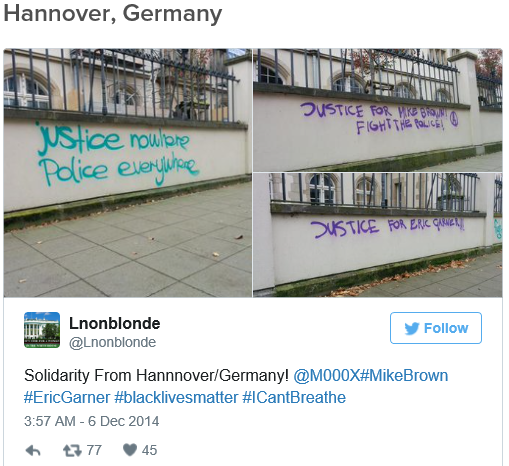
Though Black Lives Matter began in one state, it grew to one country and just as it grew throughout America, it too touched the whole world...
It even touched my home country.
The power of the Internet is truly immense. This issue has become globalised. It has reached millions of people who may have never become aware of the movement if it weren't for the social implications of the modern world. Strikes and petitions have grown immensely as a result and Black Lives Matter has achieved much because of it.
Social
campaigns are grown and molded by the culture and technology of their specific
age. Civil rights activist would use traditional media to reach the masses,
showcase their movement and hopefully bring about a change in society. Martin
Luther King for instance utilized the television to broadcast his message and
ideals.
Today’s
social movement scene is created and spread in an entirely different, and in my
belief, more effective method.
The
BlackLivesMatter movement was first conceived in 2013 following the shooting of
Trayvon Martin. The means to which it started? A single hashtag on Twitter. It
has since grown into one of the greatest social media movements which at first
was solely created and driven by the spread of thoughts through social media.
Hence this movement and its success is entirely the result of the postmodern
age and the technology it provides (e.g. Web 2.0).
As
Cullors-Brignac, a leader of the BLM movement states, "because of social
media we reach people in the smallest corners of America… there is a network
and a hashtag to gather around.
Mckesson
also builds on this emphasizing that “the tools that we have to organize and to
resist are fundamentally different than anything that’s existed before in black
struggle.”
BLM
found a means to building the campaign through the medium of social media. The
benefits of this medium include the rapid spread of information, the ability to
bring about a participatory culture for the cause and the means to
exponentially increasing the campaign’s audience. The postmodern age also
allows for Transmedia Storytelling. This concept revolves around depicting a
story across multiple media formats. BLM succeeded heavily in this as their
ideal was started in Twitter, spread throughout social media and participation
and collaboration was achieved with petitions being made and strikes being
organized online.
Benkler
depicts this rapid escalation by conveying that relatively small communities
online can reach regional and often international ones through such means. Poster
builds on this stating that such virtual communities allow for intense
experiences that build identity in the user and furthers the cause to more
audiences.
This
very interaction brought about by the postmodern age is entirely decentralized.
As Cullors-Brignac states, “you can't kill the movement by killing the leader
because there are many. But decentralization does not mean disorganization.”
BLM has managed to create an incredible participatory culture around a single
ideal through Transmedia Storytelling.
In fact
this was so successful that the movement appeared in a Law & Order episode,
a Scandal episode, a documentary called Bars4Justice and even a Macklemore song
called White Privilege.
It is
clear just how great a campaign can become through the use of technology in the
postmodern age.
A Student’s Perspective is a blog written by myself, Garrick Johnson and Joseph Badaan, both students currently attending Colorado State University. We plan to examine the #BlackLivesMatter social movement through online resources such as social media. We were both drawn to this topic because it has been such a polarizing social movement for the past few years. It has also come at a time whereby social movements can grow exponentially due to the power of virtual communication and culture. This allows us to further understand just how digital mediums can effect, mold and escalate such a cause.
Another reason both Joseph and I were interested in the #BlackLivesMatter movement is because we are able to give a unique and unbiased perspective on the whole issue. Joseph being from Australia will give an international perspective, one which is aware of the origin yet not affected by the media which has brought this matter to light so effectively throughout America. On the other hand I hope to give a different perspective as someone who has been 'outside looking in'.
As the movement has grown over the years we hope to give our readers an intelligent and unbiased analysis of the powerful social movement that is Black Lives Matter.
For our readers who may not know much about the Black Lives Matter movement, we hope this quick introduction catches you up to speed. The movement began in 2013 when the twitter hashtag #BlackLivesMatter blew into the online social sphere. This social media wildfire was sparked by the Trayvon Martin and George Zimmerman cases. Since these occurrences few more African American deaths transpired leading to great outcries throughout social media.
The movement was founded by Alicia Garza, Patrisse Cullors, and Opal Tometi who have successfully grown this issue into a significant social media powerhouse. The BLM movement continues to operate strongly online whilst demonstrations and protests occur on the streets. But has it been successful? As Blow (2015) states, the issue may have been raised but it has not been resolved.
In our following blog posts we will begin to dive deeper into the power of digital communications, their effect on social movements (particularly that of #BlackLivesMatter) and whether they can truly make a movement successful.
PS: Connect online to our social media pages to stay constantly updated! Also be sure to check out the ‘quick links’ tab for further info on the matter
Welcome to our new blog: 'A Student's Perspective' !
Throughout this blog we hope to bring to light the famous and recent social movement #BlackLivesMatter. This particular movement has grown significantly and exponentially over the past few years making it one of the more interesting movements to examine.
We shall be updating this blog weekly so be sure to connect and share our social media to know when the latest post is created and to build a large community where all can discuss our insights.
Joseph Badaan: Hello readers! I'm an Australian on exchange at the great CSU! I love all things media and look forward to providing an international perspective on the #BlackLivesMatter movement :)